Religious Trauma and LGBTQ+ Identity: How Your Location Shapes the Wound — and the Healing


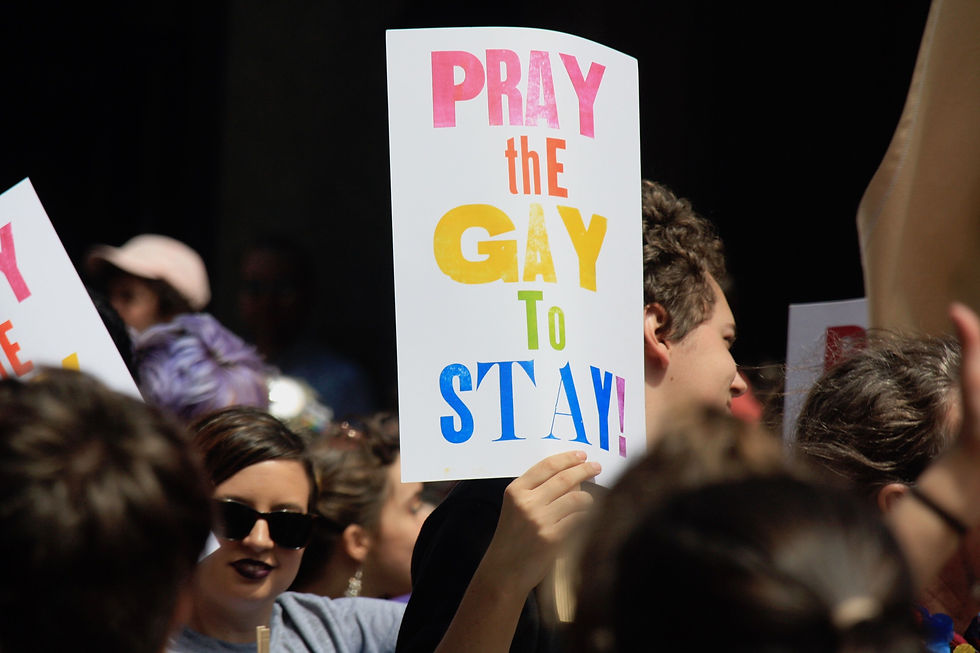
If you grew up LGBTQ+ in a religious community, you know that the harm wasn't just theological. It was relational; it was physical. It was the way your body learned to brace itself before you even knew why you were tensing up. Besides the ignorant, insulting message to "pray the gay away," there's a lingering tension that lives inside a person who has to pretend and mask.
Religious trauma shows up differently for everyone. But one factor that doesn't get enough attention is geography. Where you were when you came out — or when you realized you had to hide — shapes not just what happened to you, but how recovery looks now.
Where You Grow Up Shapes How Religious Trauma Shows Up
The core wound of religious trauma for LGBTQ+ people is remarkably consistent: you learned that a core part of who you are is unacceptable. Not only that, depending on the religion, it condemned you to hell. If you grow up feeling unacceptable to God, your parents, and your community, it’s hard not to learn to shrink to stay small and fly under the radar. You learn to hate yourself for that one aspect of your identity. That lesson gets encoded in your nervous system, not just your mind. It may shape how you treat yourself and how you relate to others.
The nature of that wound depends heavily on the environment you were navigating. A kid growing up in a progressive, diverse city faces a very different set of stressors than a child or teenager in a small conservative town where church and community are one and the same. Both carry trauma, but the recovery path has to account for the conditions where the trauma formed.
Northridge — Affirmation with Residual Damage
In and around Northridge and the broader San Fernando Valley, there's a more visible LGBTQ+ community. That leads to more affirming churches and spiritual spaces, and a wider range of therapists who understand both religious trauma and queer identity. A young person there has a better chance of finding a counter-narrative to “God hates you, sinner!” If you received the message that God loves you as you are, you might feel more acceptable socially and relationally.
However, that doesn't make the trauma disappear. The harm in these environments is often quieter — less overt condemnation, more implied tension. You might get a youth group lesson on "loving the sinner," or a pastor who never says the word "gay" but loads every sermon with talk of purity and the natural order. Your parents who vote for inclusive policies might still flinch when you hold a same-gender partner's hand.
The recovery challenge here is often about unearthing shame that was never explicitly named but was absorbed anyway. The body still learned to hide. It just got subtler about it.
Ridgecrest and the High Desert — The Isolation Multiplier
In a geographically isolated town like Ridgecrest — or a military base community like Edwards Air Force Base — the picture is often a stark contrast. Here, military or conservative religious culture may predominate. The church and the community are tightly woven together. Leaving one means leaving both.
An LGBTQ+ kid in this environment often grows up without a single visible counter-narrative--no affirming youth group, openly LGBTQ+ teacher, or affirmative therapist's office. You might be the only person you know who's questioning your sexuality or gender. The only messages you hear are that what you're feeling is wrong.
The trauma here is compounded by lack of anonymity. Everyone knows everyone. Hiding takes constant, exhausting vigilance. Your body stays on alert in a way that's hard to turn off, even years later after you've left.
Recovery has to address not just the religious wound but the profound isolation that came with it — the sense that you were the only one and escape felt impossible.
The Edwards AFB Context — A Note on Military Religious Culture
For those who grew up on or near Edwards or other military bases, there's an additional layer. Military communities often blend conservative Christian culture with a strong emphasis on order, authority, and conformity. For LGBTQ+ youth, this can mean that questioning your faith and questioning your place in the community feel like the same betrayal. The stakes of being found out feel higher. With rotating deployments and relocations, you may have grown up with less stability to build a support network your identity formation.
The Common Thread — The Body Doesn't Know Zip Codes
Here's what brings all of these experiences together: no matter where the wound happened, the healing has to happen in the body.
Whether you were openly condemned in a Ridgecrest church or quietly shamed over a Northridge dinner table, your nervous system learned the same lesson — hide, shrink, don't be fully present. That response doesn't automatically update when your environment changes. Your intellectual self-appraisal may be fully affirming, while your body still fires a fear response when you get complimented, or hold eye contact a moment too long. It can make attraction to others feel unsafe too.
This is where EMDR therapy, somatic therapy, and hypnotherapy come in. They work with the part of the trauma that lives beneath language — the gut-level response that doesn't care about your zip code or your theology.
Starting the Work with Religious Trauma and LGBTQ+ Identity
Religious trauma is not a life sentence. The shame that was coded into your body can be unwired. It helps to work with someone who understands the specific shape of LGBTQ+ religious trauma — the theological wound, the communal loss, the physical vigilance — and has tools to heal the mind and the nervous system.
I work with LGBTQ+ teens and adults across Southern California — from Northridge through the San Fernando Valley, out to the Antelope Valley, and up to Ridgecrest. If you’re ready to untangle religious trauma from your sense of self, I can help. The geography of the wound may differ, but the path back to your body is the same. If you want to learn more about how I can help you, please click the button below to schedule a free, no-pressure 15 minute consultation by phone.